
Arpeggiator Studies
For MIDI Keyboard, Max and bitKlavier


I’m thrilled to share my latest project: Arpeggiator Studies, a collection of pieces inspired by Conlon Nancarrow’s Studies for Player Piano. These works live at the intersection of mechanical precision and human improvisation and I think of these pieces as a curious blend of opposites: horrible/mesmerizing, ugly/beautiful, raw/academic, structured/chaotic.
The work exists as a Youtube album (more info below) and the arpeggiators can be downloaded for use in Ableton Live and Max here:
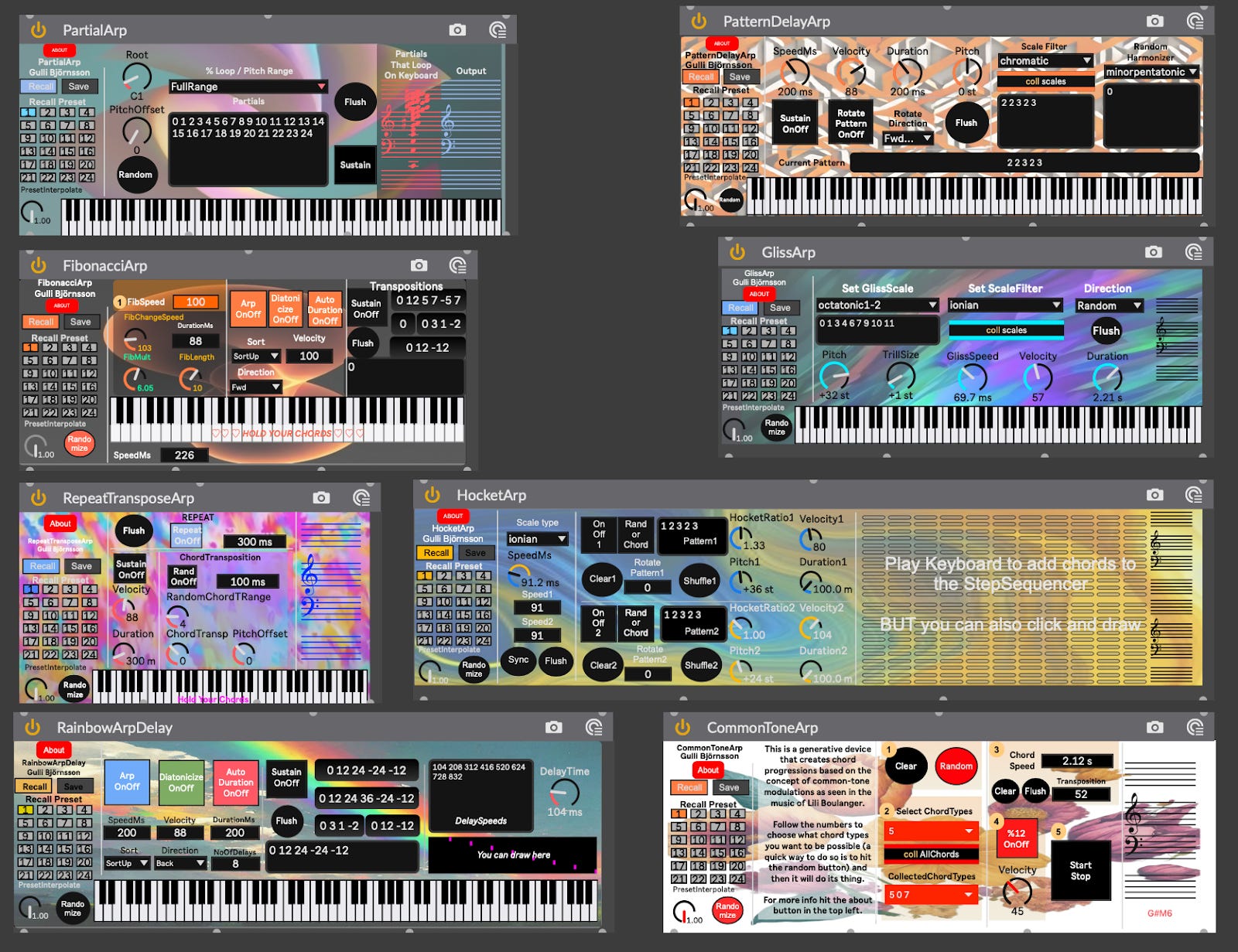
These arpeggiators are the first installment of gbFX a collection of audio and MIDI effects, synths and samplers for Max and Ableton Live. More info on the arpeggiators themselves can be found here:
The primary goal of these studies was to explore composition with the mass of notes and machine-like precision that digital arpeggiators can produce. Unlike Nancarrow’s player piano studies or “black MIDI” compositions, which rely on pre-generated piano rolls or MIDI files, these studies are designed for live performance, incorporating an improvisational dimension.
Each study focuses on a different kind of MIDI arpeggiator I created in Max and is played through Dan Trueman’s innovative prepared digital piano - bitKlavier. In these works a performer (myself, with very poor piano playing skills) improvises on a MIDI keyboard that goes through arpeggiators that processes the simple keyboard input into something bigger. Many of the arpeggiator’s parameters are automated through an automation editor I developed in Max, providing a pre-structured framework for the improvisation.
The visualization is done through the BACH package in Max developed by Andrea Agostini and Daniele Ghisi. The studies are conceived as audio-visual works, as I believe that seeing the real-time notation is crucial to the experience.
Following is information about each study along with the youtube link to the album.
Takk!
- Gulli
Arpeggiator Study no.1 - 6 Arpeggiators with an Intervallic Delay
In this study I layered 6 conventional arpeggiators, where a held chord creates that iconic arpeggiator sound. The 6 arpeggiators have a delay, and are programmed to start in different registers across 5 octaves. This creates an arpeggiator that effectively plays across the range of the piano at all times, with a cascading delay sound. The clock speed evolves over time through pre-determined automation lanes, adding rhythmic variations that get pretty chaotic at times.
Arpeggiator Study no.2 - Velocity to: Fibonacci Rhythm Arpeggiator or Large Resonant Chords
This study uses two arpeggiators, and note velocity to determine which of the two gets triggered, creating contrasting textures:
Soft Notes (Velocity < 100): Activate the blue arpeggiator, which cycles through new pitches every 4 seconds. The pulse is irregular, derived from the Fibonacci series, and generates dyads either within a single octave or across multiple octaves.
Loud Notes (Velocity > 100): Trigger the yellow arpeggiator, producing doubled notes in octaves with a resonant reverb.
I used Two BitKlaviers in different tunings for each arpeggiator (Rameau tuning for blue soft notes, Kirnberger III for loud yellow notes).
Arpeggiator Study no.3 - Chord Glissandos
Here each played note becomes a three note chord which then moves as a glissando. I was envisioning being able to play a chord that would then ‘slide’ across the piano rapidly. The glissandos go through an interscalar transposition, from chromatic to pentatonic and are sent randomly up and down in register. I decided to use the super cool “Spring Tuning” in BitKlavier for this one, set up to adjust between grammateus and just tuning, aiming for a particularly pure sound.
Arpeggiator Study no.4 - Stretched and Sped Up
This semi-generative study explores the paradox of simultaneously slowing down and speeding up. Using the live.grid object in Max as a step sequencer, the system dynamically adjusts:
Slowing down by lengthening the grid.
Speeding up by moving faster through the grid.
There are four of these step-sequencers running simultaneously, represented by four different colors, each one pre-programmed to move slightly differently. The performer can rotate and scramble the order of the four scales, control the volume of each scale and add pitch-bends to notes.
Arpeggiator Study no.5 - Really Fast Hocketing
This one is also semi-generative and is centered around two live.grid step-sequencer Max objects (blue and yellow) with looping rhythmic patterns (13568 and 12578). When a note is pressed, each chromatic note will show up as a row in live.grid tied to the above rhythmic pattern. The clock speed is multiplied with varying ratios (1.618, 1, 0.75, 0.66, 0.5) to create fast-moving hocketing patterns between two pianos. The step sequencer then transposes the chromatic notes to a pentatonic scale. The performer varies the clock speed and the length of the patterns with dials on the keyboard.
Arpeggiator Study no.6 - Large Overtone Chords
The keyboard input matches the ET notes of the first 10 or so partials of the overtone series. I originally made this pitch mapping for a laptop ensemble piece called “Greatest Hits” where performers use a laptop keyboard to turn words into chords. The bitKlavier tuning is “partial,” and the ADSR envelope on the piano note is quite extreme, giving it a synth-like sound. The automation controls a slow pitch bend up and down a half step throughout the piece.
Arpeggiator Study no.7 - Really Fast Chords
The title explains the main idea here but there is more to it! I have to give a big shout out to Dmitri Tymaczko for showing me his cool theory on chord transpositions and for helping with some of the patching in Max. There are two transpositions that are being automated here, one is transposition along the chord and the other along a scale. Here the performer controls the velocity (to create swells), and the speed of the chords with two dials while gradually adding notes to a collected note bank - creating a large chord by the end. This big chord is continually being transposed randomly through Tymaczko’s transposition along the chord and scale, the rate of which is being modulated through the automation editor throughout the piece.
Arpeggiator Study no.8 - Pattern Delays
A pattern delay is a delay effect that can be irregular, creating rhythmic patterns on the delay line f.x. 2 4 3 2 3. I remember when Dmitri Tymaczko showed this idea of a pattern delay in class at Princeton and I was struck with how perceptually complicated it was to understand what was going on when listening to it. Here I used two pattern delay arpeggiators that both cycle through the long palindromic pattern: 12 11 10 9 8 7 6 5 4 3 2 1 1 1 1 2 3 4 5 6 7 8 9 10 11.
There are two arpeggiators, one visualized in green and the other in black, and by experimenting with the pitch range, I discovered a fascinating register that extends beyond the piano’s range, both super low and extremely high.The piece begins in this range, and then moves across the piano’s full register, eventually returning to the starting point. As actually I did in most of these studies, the pitches wrap around the high and low range (like 5 degrees being the same as 365).
Partly due to frustration of making comprehensible music to some extent with this arpeggiator I added a Nostalgic preparation in bitKlavier that plays the incoming notes backwards for an added sonic texture. The tuning here was sixth-comma meantone.
Arpeggiator Study no.9 - Common Tones
An homage to Lili Boulanger, this generative study cycles through chordal changes from the middle section of Boulanger’s piece “Renouveau,” featuring extended chords and common tone modulations. The result is highly chromatic, and I chose to use “just” tuning in bitKlavier, creating fascinatingly jarring sonorities at times. The automation in this study is unconventional as the Max patch cycles through the automation randomly rather than linearly, with deliberate pauses in between.
 | A guest post by
|